 Your Success, Our Priority: Our team is here to assist you!

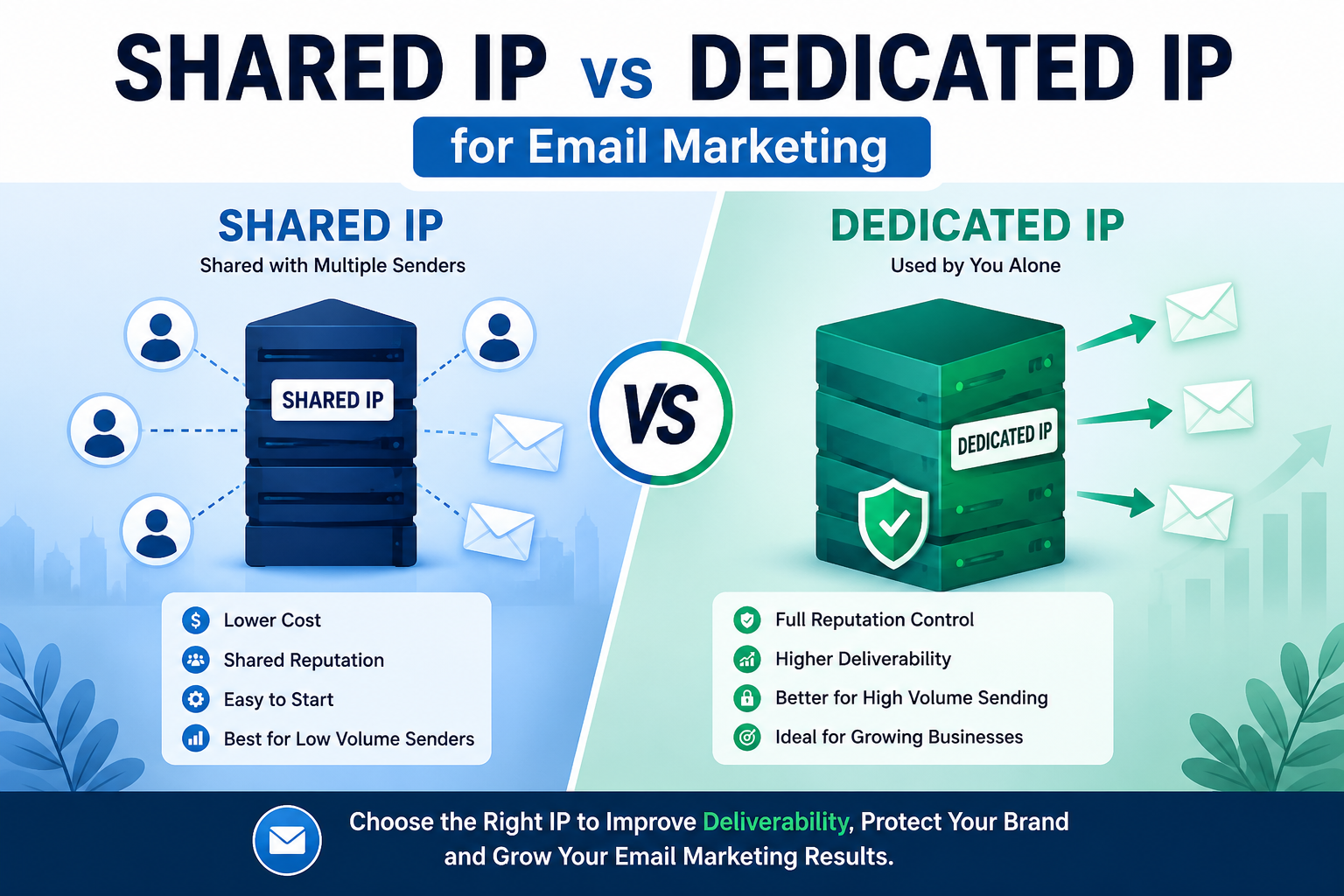
When choosing an email delivery solution, one of the most important decisions is whether to send emails through a shared IP or a dedicated IP. For businesses comparing shared IP vs dedicated IP email marketing, the right choice depends on sending volume, reputation control, budget, deliverability goals, and long-term growth.
Both options can work well when managed correctly. However, they serve different types of senders. A shared IP is often suitable for low-volume or beginner email marketing, while a dedicated IP gives businesses more control over sender reputation, deliverability, and campaign performance.
In this guide, we will compare shared IP and dedicated IP for email marketing so you can choose the right option for your business.
What Is a Shared IP in Email Marketing?
A shared IP is an IP address used by multiple senders to send emails. Instead of having your own sending IP, your campaigns are delivered through an IP pool shared with other businesses.
This is common in entry-level email marketing plans because it is affordable and easy to start. If your business sends a small number of emails each month, a shared IP may be enough.
For example, SMTPProvider offers flexible SMTP solutions for businesses that need cost-effective email sending. You can compare available options on the SMTP pricing page.
What Is a Dedicated IP in Email Marketing?
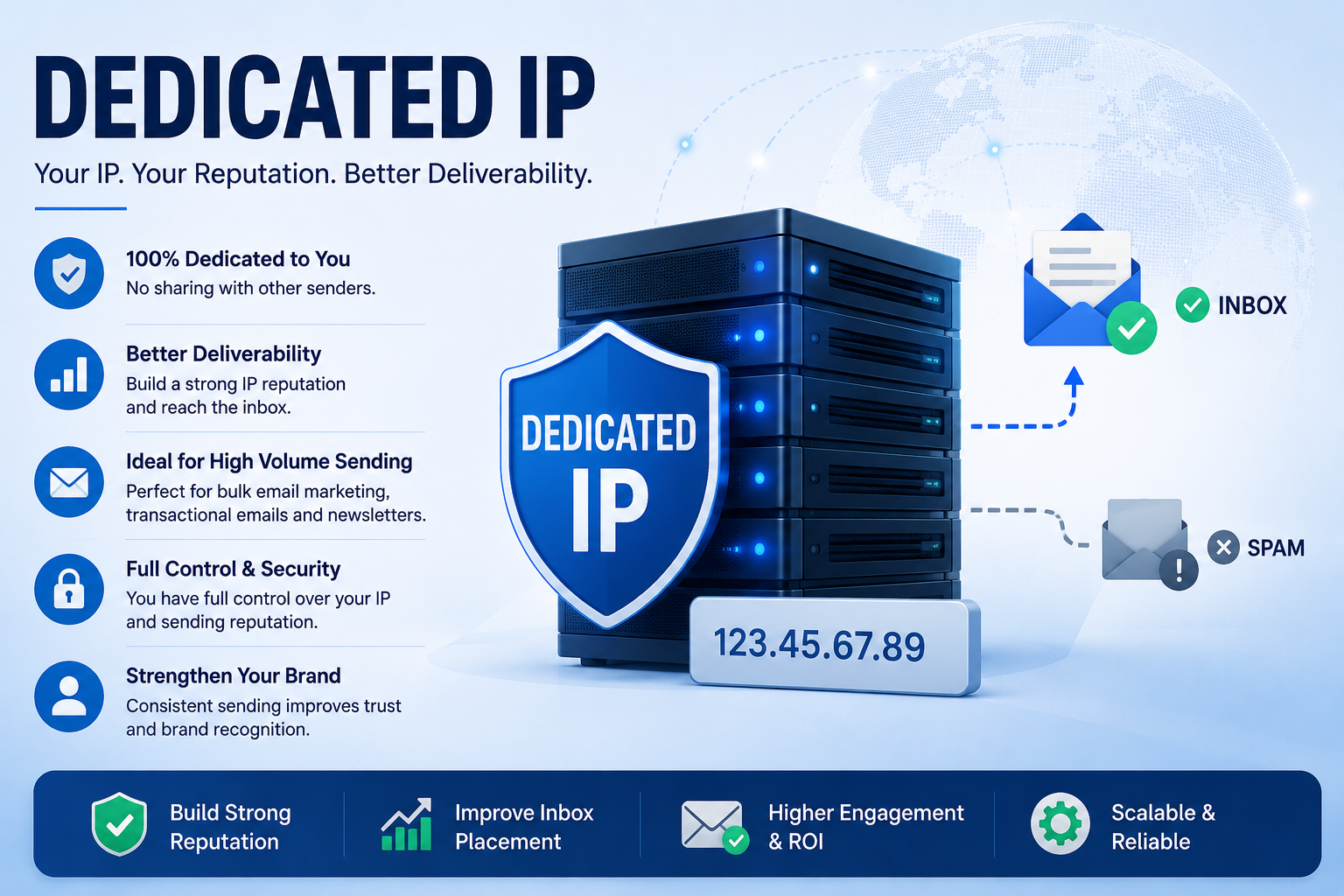
A dedicated IP is an IP address used only by your business. Your email campaigns are sent from your own IP, and your sender reputation is not directly affected by other senders.
This makes dedicated IPs valuable for businesses that send high-volume campaigns, transactional emails, newsletters, promotional emails, or customer communication at scale.
With a dedicated IP, you get better control over IP reputation, sending volume, warm-up strategy, authentication, and long-term deliverability. SMTPProvider offers dedicated IP options with high-volume SMTP plans. You can view them here: Dedicated IP SMTP Plans.
Shared IP vs Dedicated IP Email Marketing: Quick Comparison
| Feature | Shared IP | Dedicated IP |
|---|---|---|
| Best for | Small senders, beginners, low-volume campaigns | Growing businesses, high-volume senders, serious marketers |
| Cost | Lower cost | Higher investment |
| Reputation control | Shared with other users | Fully controlled by your business |
| Setup effort | Easier to start | Requires IP warming and management |
| Deliverability impact | Depends on shared pool quality | Depends on your own sending behaviour |
| Volume suitability | Low to moderate volume | Medium to high volume |
| Risk | Other senders may affect reputation | Your own practices determine reputation |
| Brand control | Limited | Stronger sender identity |
| Long-term scalability | Limited | Better for scaling |
Benefits of Using a Shared IP
A shared IP can be a practical option for businesses that are just starting with email marketing.
1. Lower Starting Cost
Shared IP plans are usually more affordable because the infrastructure cost is shared among multiple users. This makes them useful for startups, small businesses, and low-volume senders.
2. Easier Setup
With a shared IP, you do not need to manage IP warming from zero. The IP pool may already have sending history, which can help new senders start faster.
3. Good for Small Campaigns
If you send a few thousand emails per month, shared IP sending can be enough. It allows your business to test email marketing without committing to dedicated infrastructure.
4. Less Technical Management
Shared IPs are usually easier for beginners because the provider manages much of the sending infrastructure. You can focus on creating campaigns, improving content, and growing your audience.
Limitations of Shared IP

Shared IPs are affordable, but they also come with limitations.
1. Reputation Is Shared
Your deliverability can be influenced by other users sending from the same IP pool. If another sender has poor email practices, high bounce rates, or spam complaints, the shared IP reputation may suffer.
2. Less Control
You cannot fully control the sending behaviour of others on the same IP. This makes shared IPs less ideal for brands that need consistent inbox placement.
3. Not Ideal for High Volume
As your sending volume grows, shared IPs may become less suitable. High-volume campaigns need better reputation control, throttling, monitoring, and dedicated infrastructure.
4. Limited Sender Identity
A shared IP does not give your business the same level of technical identity as a dedicated IP. For serious email marketing, reputation ownership becomes important.
Benefits of Using a Dedicated IP
A dedicated IP is usually the better choice for businesses that treat email as a serious sales, marketing, or customer communication channel.
1. Full Reputation Control
With a dedicated IP, your sender reputation belongs to your business. Other senders cannot directly damage your IP reputation. Your deliverability depends on your own list quality, engagement, bounce rates, authentication, and sending consistency.
2. Better for High-Volume Sending
If your business sends large campaigns, newsletters, promotional emails, or transactional messages, a dedicated IP gives you more control over delivery performance.
SMTPProvider’s Unlimited SMTP Plans include dedicated IP options for businesses that need scalable sending.
3. Stronger Deliverability Management
A dedicated IP allows you to build a stable sending reputation over time. When combined with SPF, DKIM, DMARC, bounce control, unsubscribe handling, and proper warm-up, it can support stronger email deliverability.
You can also read more about deliverability here: Email Deliverability Guide.
4. Better Brand Protection
Businesses that send important emails should avoid unnecessary reputation risk. A dedicated IP helps protect your brand from the behaviour of unrelated senders.
5. More Predictable Performance
With a dedicated IP, you can analyse campaign results more accurately because the IP reputation is based on your own sending activity. This makes it easier to identify what is working and what needs improvement.
Limitations of Dedicated IP
A dedicated IP is powerful, but it must be managed correctly.
1. Requires IP Warming
A new dedicated IP should not be used for large campaigns immediately. You need to warm it up gradually by increasing sending volume over time. This helps mailbox providers recognise your sending pattern as legitimate.
2. Higher Cost
Dedicated IPs usually cost more than shared IPs. However, for businesses that depend on email revenue, better control and scalability can justify the investment.
3. Your Sending Practices Matter More
With a dedicated IP, your reputation is fully your responsibility. Poor list quality, high bounce rates, spam complaints, or inconsistent sending can damage your own IP reputation.
Which One Is Better for Email Deliverability?

The answer depends on your sending behaviour.
A shared IP can deliver well if the provider maintains a clean IP pool and your sending volume is low. However, you have limited control over reputation.
A dedicated IP can provide better long-term deliverability if your business follows proper sending practices. This includes:
- Sending to permission-based contacts
- Keeping bounce rates low
- Using SPF, DKIM, and DMARC
- Warming up gradually
- Sending consistently
- Removing inactive contacts
- Including unsubscribe links
- Monitoring complaints and delivery reports
For businesses that want more control over email deliverability, dedicated IP is usually the stronger option.
When Should You Use a Shared IP?
A shared IP may be suitable if:
- You are new to email marketing
- You send low email volume
- Your budget is limited
- You do not send daily campaigns
- You want a simple starting option
- You are testing email marketing before scaling
For small campaigns, shared IP plans can be a cost-effective way to begin. You can compare available options on the SMTP pricing page.
When Should You Use a Dedicated IP?
A dedicated IP is a better option if:
- You send high-volume email campaigns
- You need better reputation control
- Email is important for sales or customer retention
- You send transactional emails, invoices, OTPs, or alerts
- You want predictable inbox placement
- You are scaling newsletters or promotional campaigns
- You want your own sender reputation
- You need dedicated SMTP infrastructure
If this sounds like your business, consider SMTPProvider’s Dedicated IP SMTP Plans.
Shared IP vs Dedicated IP for Bulk Email Marketing
For bulk email marketing, a dedicated IP is generally the better long-term choice.
Bulk campaigns require stable infrastructure, reputation monitoring, authentication, bounce control, and gradual scaling. A shared IP may work for smaller campaigns, but it may not offer the same level of control when volume increases.
If your business sends promotional campaigns, newsletters, customer updates, or lead nurturing emails, a dedicated IP can help you build a stronger sender reputation over time.
You can also connect your website, CRM, app, or marketing tool with a reliable SMTP server for scalable sending.
Cost Comparison: Shared IP vs Dedicated IP
Shared IPs are cheaper at the beginning. They are ideal for small senders who want to keep costs low.
Dedicated IPs require a higher monthly investment, but they offer stronger control, scalability, and reputation ownership.
The real question is not only “Which one is cheaper?” The better question is:
How important is email performance to your business revenue?
If email marketing is a small side channel, shared IP may be enough. If email drives sales, leads, onboarding, retention, or customer communication, dedicated IP is usually worth the investment.
Final Verdict: Shared IP or Dedicated IP?
For small businesses and beginners, shared IP email marketing is a simple and affordable starting point.
For growing businesses, high-volume senders, and brands that care about deliverability, a dedicated IP is the better long-term solution.
If your business wants more control over sender reputation, better scalability, and stronger email delivery management, choose a dedicated IP with a reliable SMTP provider.
Start Sending with SMTPProvider
SMTPProvider helps businesses send marketing emails, transactional emails, newsletters, and bulk campaigns through reliable SMTP infrastructure.
Whether you need affordable shared IP plans or high-volume dedicated IP sending, SMTPProvider gives you flexible options for your business.
FAQs
1. What is the difference between shared IP and dedicated IP in email marketing?
A shared IP is used by multiple senders, while a dedicated IP is used only by one business. Shared IPs are cheaper, but dedicated IPs offer more reputation control.
2. Is dedicated IP better for email marketing?
Yes, a dedicated IP is usually better for businesses that send high-volume campaigns or need stronger control over sender reputation and deliverability.
3. Is shared IP bad for email deliverability?
Not always. A shared IP can work well for small senders if the IP pool is properly managed. However, your reputation may be affected by other senders using the same IP.
4. Do I need a dedicated IP for bulk email?
If you send bulk emails regularly, a dedicated IP is recommended because it gives you better control, scalability, and long-term sender reputation.
5. Does a dedicated IP improve inbox placement?
A dedicated IP can support better inbox placement when combined with good email practices, proper authentication, list hygiene, and gradual IP warming.